
Where I go to recharge from the daily challenges of NMOSD
At the lake, I reconnect with parts of myself that can get buried
Written by |





As someone living with neuromyelitis optica spectrum disorder (NMOSD), I have learned that life is a delicate balance between caution and courage. There are times when rest is essential and times when I need to push myself beyond my comfort zone.
Protecting my health doesn’t mean putting my life on hold. In fact, some of my most meaningful moments have come from doing things that make me a little afraid. That’s why one of my favorite places is Muskoka, an area in Ontario, Canada, that reminds me how to rest, recharge, and occasionally be brave.
I love when the landscape starts to change on the drive up north. Concrete gives way to the Canadian Shield. Granite rock faces rise along the roadside, and if you pay attention, you’ll spot inukshuks perched in random places that welcome you to the north.
Muskoka is described as Ontario’s cottage country. It is known for its dense forests, clear lakes, and small waterfront communities. But to me, Muskoka is something more personal. It is a reset button.
I need the clean air, the vast lakes, and the quiet surroundings just as much as I need my gabapentin, Suboxone (buprenorphine and naloxone), and physiotherapist. I need the reminder of why I continue to fight this rare disease. My reset is my motivation, and there is no better place than the Great North.

Lessons from the lake
Muskoka is also where I fell in love with boating. Years ago, my dad bought a 24‑foot boat for family adventures, despite having almost no boating experience. As an immigrant who couldn’t even swim, he still saw the magic of the Muskoka waterways and wanted us to experience it. He’s the one who taught me how to safely captain a powerboat.
One of his first lessons was unforgettable: Boats don’t have brakes. That truth gets your attention fast. Every approach to a dock or slip demands planning, patience, and skill. You learn to read the wind, understand momentum, and trust your judgment. Docking isn’t something you can fake; you have to get it right every time.
Living with a rare disease feels similar. You navigate uncertainty, prepare for shifting conditions, and make decisions even when the path ahead isn’t fully clear. Like approaching a dock on a windy day, NMOSD has taught me to respect risk without getting stuck in treatment decision-making, and to keep moving forward, even when staying safely anchored feels easier.
Steering through uncertainty
Recently, I captained a boat again, something I haven’t done in years. There’s always a moment of hesitation when I take the wheel, but then the familiarity returns. The weight of the steering wheel in my hands. The rhythm of the water against the hull. The wind rushing through my hair and the cool spray hitting my face. The shoreline blurs into greens and granite, and for a little while, every responsibility waiting for me back home fades into the background.
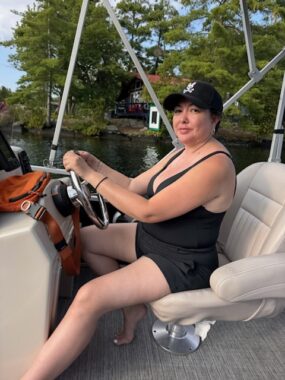
Columnist Jennifer V. drives a powerboat during a trip to northern Canada in August. (Courtesy of Jennifer V.)
Soon, fear gives way to freedom.
Living with NMOSD has brought more than my share of frightening moments: diagnoses, relapses, pain, uncertainty, and the constant awareness that life can shift without warning. Those experiences have taught me that I cannot let fear shrink my world. Sometimes I need to do things that scare me a little. Not reckless things but meaningful things.
Life is too short to stay anchored by fear. Every time I step behind the wheel of a boat, I’m reminded that confidence is rebuilt through action, not by waiting.
Anchored in nature, not in fear
Muskoka is where I reconnect with parts of myself that can get buried beneath everyday responsibilities and health challenges. There’s something restorative about a quiet lake, surrounded by trees, with nowhere to be and nothing demanding my attention.
I spend so much time managing symptoms, attending appointments, navigating uncertainty, and carrying fears about what the future may hold that I can start to feel burnt out.
That’s why finding places that restore me is just as important as finding treatments that help me. Out on the water, feeling the wind on my face and the sun on my skin, I am not thinking about MRIs, medications, or what might happen tomorrow. I am simply present.
Life is meant to be lived, not merely managed. Fear may always travel with me, but it doesn’t deserve to be the captain. Sometimes the bravest thing I can do is take hold of the wheel, point myself toward something that brings me joy, and trust myself enough to leave the dock.
Note: Neuromyelitis News is strictly a news and information website about the disease. It does not provide medical advice, diagnosis, or treatment. This content is not intended to be a substitute for professional medical advice, diagnosis, or treatment. Always seek the advice of your physician or other qualified health providers with any questions you may have regarding a medical condition. Never disregard professional medical advice or delay in seeking it because of something you have read on this website. The opinions expressed in this column are not those of Neuromyelitis News or its parent company, Bionews, and are intended to spark discussion about issues pertaining to neuromyelitis optica spectrum disorder.


Leave a comment
Fill in the required fields to post. Your email address will not be published.