
BAT4406F for NMOSD
 Fact-checked by
 What is BAT4406F for NMOSD?
BAT4406F is an experimental, antibody-based therapy being studied as a potential treatment for people with neuromyelitis optica spectrum disorder (NMOSD) who test positive for antibodies against the aquaporin-4 (AQP4) protein.
In NMOSD, the immune system mistakenly attacks healthy parts of the nervous system, most often damaging the spinal cord and the optic nerve, which carries visual signals between the eyes and the brain.
For most people with NMOSD, anti-AQP4 antibodies play a central role in these attacks. These antibodies are produced by immune cells called B-cells.
BAT4406F is designed to bind to the CD20 protein on the surface of B-cells, leading to their depletion. By reducing B-cell levels, the therapy is expected to lower production of the antibodies that drive NMOSD symptoms.
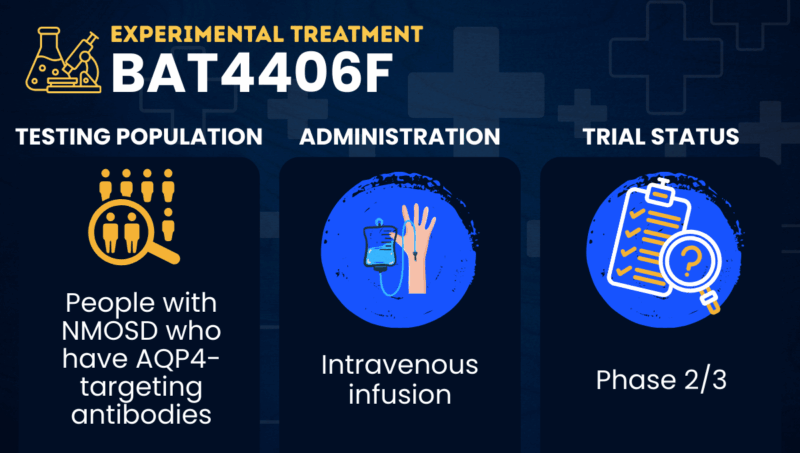
BAT4406F is being developed by Bio-Thera Solutions and is given through intravenous infusions into the bloodstream. The therapy is currently being tested in a Phase 2/3 clinical trial for NMOSD. Based on positive trial results, the company has said it plans to seek regulatory approval in China and explore the therapy’s use for other conditions.
Therapy snapshot
| Treatment name | BAT4406F |
| Administration | Intravenous infusion |
| Clinical testing | Currently in Phase 2/3 clinical testing for NMOSD |
How will BAT4406F be administered in NMOSD?
In NMOSD clinical trials, BAT4406F has been given via intravenous infusion. In the Phase 2/3 trial, the therapy is administered once every six months at a dose of 500 mg.
BAT4406F in NMOSD clinical trials
BAT4406F is being evaluated in a Phase 2/3 clinical trial (NCT06044350) in China involving adults with NMOSD and anti-AQP4 antibodies. Participants were randomly assigned to receive two infusions of BAT4406F (500 mg) or a placebo, given six months apart.
The study’s primary goals were to evaluate the treatment’s effects on B-cells and anti-AQP4 antibody levels, along with its other pharmacological properties.
In 2025, the company announced that enrollment in the Phase 2/3 trial would close early because the therapy was already showing strong signs of efficacy, with statistically significant superiority over placebo.
A previous Phase 1 study (NCT04146285) evaluated the effects of a single infusion of BAT4406F at different dose levels in 15 adults with NMOSD. The study found that BAT4406F:
- rapidly reduced B-cell levels, with higher doses leading to near-complete B-cell depletion lasting for up to six months
- reduced disease-related disability at some dose levels
- reduced signs of inflammation and damage in the spinal cord and optic nerve in some participants
BAT4406F side effects
In the Phase 1 study, the most common side effects of BAT4406F included:
- elevated body temperature or fever
- increased heart rate
- feeling cold
- urinary tract infection
- elevated blood pressure
- increased blood levels of lactate dehydrogenase, a marker of tissue damage
- increased fibrin D-dimer levels, a marker of blood clots or tissue damage
- chest discomfort
- abnormally rapid breathing
- itchy, red skin rash (allergic dermatitis)
About one-quarter of participants experienced infusion-related side effects, all of which were mild to moderate in severity.
Neuromyelitis News is strictly a news and information website about the disease. It does not provide medical advice, diagnosis, or treatment. This content is not intended to be a substitute for professional medical advice, diagnosis, or treatment. Always seek the advice of your physician or other qualified health provider with any questions you may have regarding a medical condition. Never disregard professional medical advice or delay in seeking it because of something you have read on this website.