17-year-old advocate shares her NMOSD story to raise awareness
Written by |
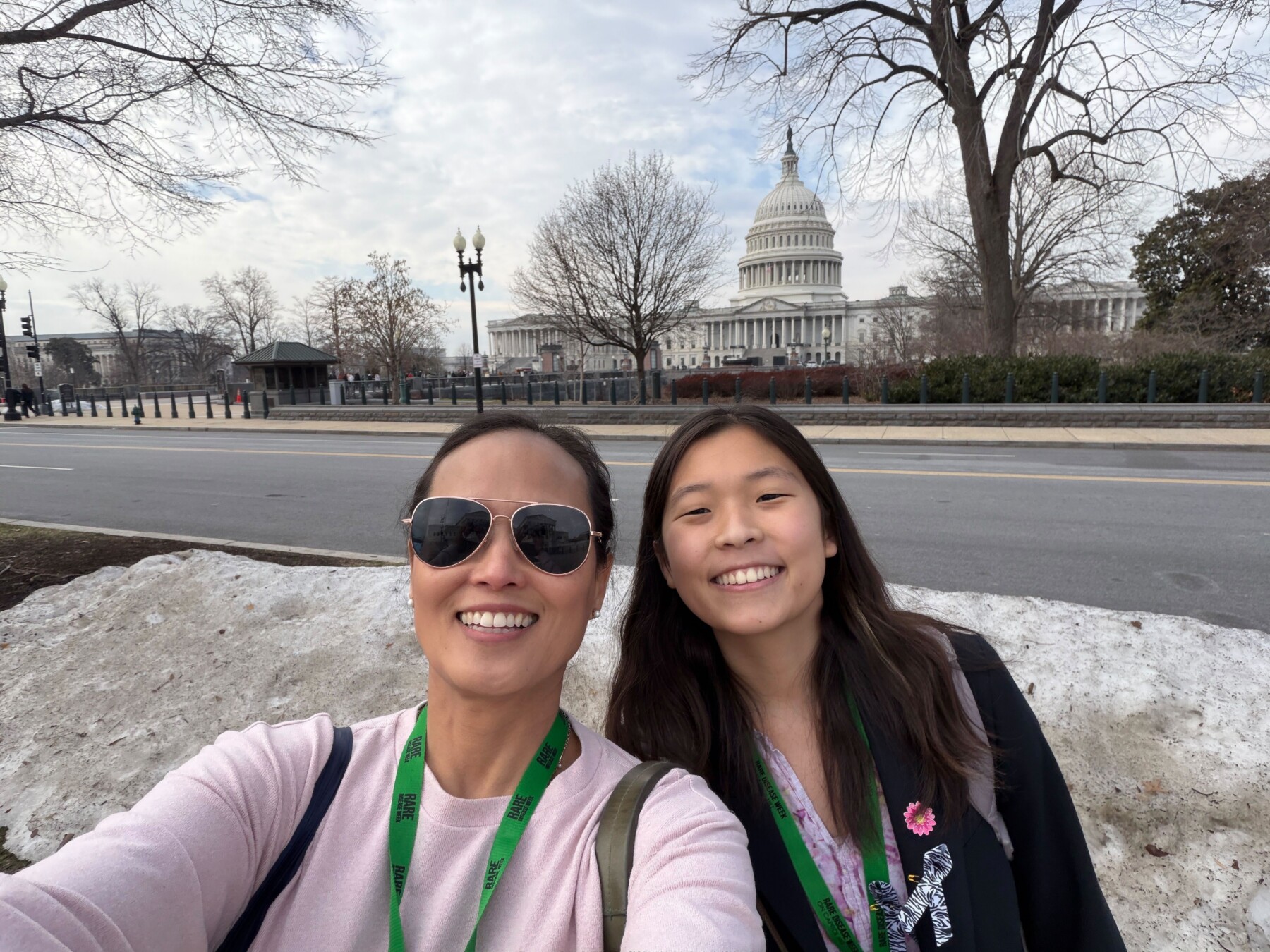
Nell Choi, right, and her mom, Maggie Kang, take a selfie with the U.S. Capitol in the background while in Washington, D.C., for Rare Disease Week. (Photo by Maggie Kang)




In 2018, when Nell Choi was 9 years old, she began experiencing symptoms that led to hospitalization and a diagnosis of neuromyelitis optica spectrum disorder (NMOSD), type positive.
A month later, when Nell came home, she was weak, in a wheelchair, and had lost 20 pounds. To cope with all the changes in her life, Nell started writing in a journal. It eventually became the book “My Hospital Story.” Nell hoped it would help other children feel less alone during hospital stays.
Now a high school junior, Nell lives with her parents in McLean, Virginia. (Her brother is in college.) She continues to share her story to heighten awareness of NMOSD and other rare diseases.
In 2022, she was a winner of the EveryLife Foundation’s Rare Artist Contest for her clay sculpture “Elephant in the Room.” It was inspired by her desire to promote greater compassion within the rare disease community. That same year, she was recognized as a Global Genes Rare Rising Star.
At age 17, Nell remains a passionate rare disease advocate. She is a junior ambassador for The Sumaira Foundation, an international patient advocacy organization. And she recently participated in the annual Rare Disease Week on Capitol Hill for the fourth time.
In the following conversation, Nell is joined by her mother, Maggie Kang, MD, a radiologist and rare disease advocate.
The interview has been excerpted and lightly edited for clarity.
MC: Talk a bit about your early symptoms.
NC: For me, I didn’t have the typical optic neuritis. At first, there were a lot of flu symptoms. like nausea, extreme fatigue. I felt extremely dizzy and wanted to sleep all the time. And then it gradually progressed into losing the ability to swallow my saliva, and loss of mobility in my right arm. The secretion buildup definitely caused a lot of respiratory issues as well.
MK: She had paralysis of her cranial nerves. Most of her manifestations were in her brainstem. Not so much the optic nerve or spinal cord involvement.
How are you feeling these days?
I’m doing so much better. It’s been a bumpy road. But doing so much better these past few years. I’m actually starting to feel, like, healthy consistently, and it’s really wonderful.
Is there a symptom that bothers you the most?
Fatigue. I’ve had this condition for about eight years now, and it’s taught me a lot about being responsible for maintaining my health. I’m very health-conscious. I exercise as much as I can, eat well, sleep a lot, and really prioritize my health more than probably most people my age.
MK: She’s a very good self-advocate.
How does fatigue affect your social life?
It depends. Sometimes I’ll just kind of hide it, or other times I’ll be, like, hey, I’m not feeling my best today. My friends are generally understanding of it. They don’t really question it. Sometimes it feels a little frustrating, though, when I have to sacrifice hanging out or doing some activity to make sure I get the rest I need.
What does it [the first World NMOSD Awareness Day on March 27] mean to you?
It means a lot. Especially with a rare condition, getting that level of visibility and awareness across the world. To have more physicians become aware of the condition and to be able to better recognize it and diagnose and treat it, that’s huge.
Let’s talk about Rare Disease Week. How did it go?
The first day or so, the advocates met together, and we learned about the different legislative “asks” that we’re going to be proposing, and asking our legislators to cosponsor or support, and it was super enlightening. It was incredibly meaningful, learning, as well as connecting, and hearing the stories of the other advocates.
I was also on an arts and health panel, which featured several recent Rare Artist awardees, including myself, and we spoke about how we use our art for advocating and for telling our stories, and for encouraging others to do the same.
MK: The second day is a full day of conferences, so that they go through all the legislative “asks” and they teach you how to make your ask and understand what you’re asking for. The third day, for the legislative meetings, that’s when everybody goes on the Hill.
This is your fourth time. Are you feeling more comfortable?
Yes, definitely. The first year, I was honestly pretty nervous walking into the big senate buildings with the marble floors, and all these offices, and just being vulnerable and telling my story. Now I feel like I’m in a position to help other advocates who might be feeling similarly.
This year, I was a mentor to someone who is a little bit newer to advocacy, and a fellow teen, and it was really nice to be able to connect with her. We really bonded and now she’s a friend of mine.
Why did you start advocating?
The door opened into this legislative advocacy space in 2022 when I submitted this elephant sculpture that I’d made in the EveryLife Rare Artist program. Rare disease is like living with an invisible rare condition. It often feels like the elephant in the room, like even if I tell someone about it, they don’t want to understand it. The EveryLife Foundation was my segue into advocacy.
How did the book come about?
It started with a journal when I got out of the hospital. I was processing a lot of what I’d been through, which I felt like no one could truly understand. The difficult emotions I was experiencing. That combined with remembering seeing other kids in the hospital and wondering whether they felt lonely as I did. I wanted to write a book to help other kids in similar situations feel less alone despite going through a difficult experience.