MIL62 for NMOSD
 Fact-checked by
What is MIL62 for NMOSD?
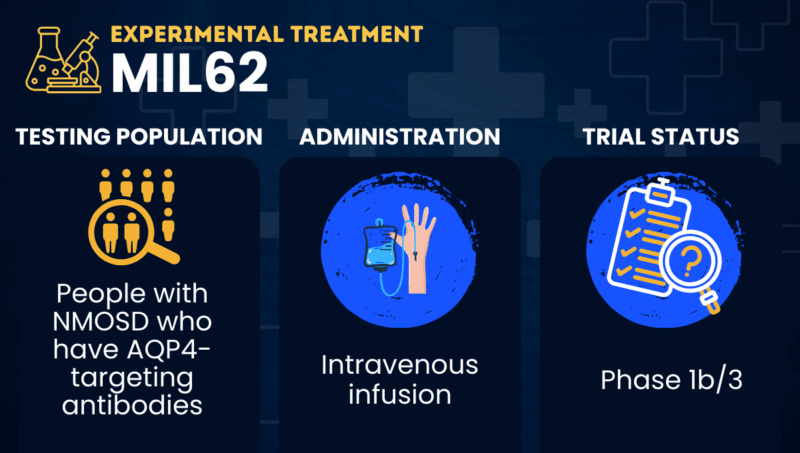
MIL62 is an experimental, antibody-based therapy being tested as a treatment for people with neuromyelitis optica spectrum disorder (NMOSD) who test positive for antibodies targeting the aquaporin-4 (AQP4) protein.
NMOSD is caused by mistaken immune attacks on healthy parts of the nervous system, which are most often driven by self-reactive antibodies that target the nervous system protein AQP4. The spinal cord and optic nerve at the back of the eye are typically most affected.
MIL62 is designed to ease NMOSD symptoms by reducing levels of the disease-driving antibodies. It binds to a protein called CD20 that’s found on the surface of B-cells, the immune cells that make these antibodies. This promotes B-cell destruction, which is expected to lower the production of harmful self-reactive antibodies.
The therapy is given via into-the-vein (intravenous) infusions. It is being developed by Mabworks, which is sponsoring a Phase 1b/3 clinical trial to test the therapy in people with NMOSD.
MIL62 is under regulatory review in China for the treatment of NMOSD. Mabworks is also testing MIL62 as a treatment for certain autoimmune kidney diseases, including kidney inflammation related to lupus, and some types of lymphoma.
Therapy snapshot
| Treatment name | MIL62 |
| Administration | Intravenous infusion |
| Clinical testing | Currently in Phase 1b/3 clinical testing for NMOSD |
How will MIL62 be administered in NMOSD?
Clinical trials involving participants with NMOSD are testing MIL62 as an intravenous infusion.
In a Phase 1b/3 study, participants are receiving doses of either 500 mg or 1,000 mg. After receiving four initial doses within the first six months, participants will receive a single maintenance infusion every six months thereafter.
MIL62 in NMOSD clinical trials
A Phase 1b/3 clinical trial (NCT05314010) is testing MIL62 in adults with NMOSD and anti-AQP4 antibodies. The Phase 1b portion focuses on safety, while the placebo-controlled Phase 3 portion focuses on efficacy.
In the Phase 3 part, participants received MIL62 or a placebo and were monitored for disease relapses and other clinical outcomes for up to a year. Data from this part of the study showed:
- significantly fewer people on MIL62 experienced a relapse compared with the placebo group (4.4% vs. 45.7%), and the annual relapse rate was lower with MIL62 (an average of 0.092 relapses per year versus 1.18 relapses per year)
- the treatment group had slower accumulation of active lesions — areas of new or worsening inflammation and damage — on MRI scans
- MIL62 was associated with reductions in disability, compared with worsening disability in the placebo group
- treatment significantly reduced levels of AQP4-targeting antibodies
- participants in the MIL62 group reported significantly better health-related quality of life than participants in the placebo group
In an ongoing open-label extension period, all Phase 3 trial participants are eligible to receive long-term MIL62.
MIL62 side effects
The specific side effects of MIL62 in NMOSD clinical trials have not been reported. In the Phase 3 part of the trial, serious safety events occurred in 11.1% of participants in the MIL62 group, compared with 6.5% in the placebo group.
Neuromyelitis News is strictly a news and information website about the disease. It does not provide medical advice, diagnosis, or treatment. This content is not intended to be a substitute for professional medical advice, diagnosis, or treatment. Always seek the advice of your physician or other qualified health provider with any questions you may have regarding a medical condition. Never disregard professional medical advice or delay in seeking it because of something you have read on this website.